Texas insurance guide · 11 minute read
How to compare auto insurance in Texas
The lowest premium is only meaningful when the liability limits, driver assumptions, vehicle coverage, and optional protections match.
InsuredNear editorial review · Last reviewed August 9, 2026
Follow a matched-quote shopping sequence
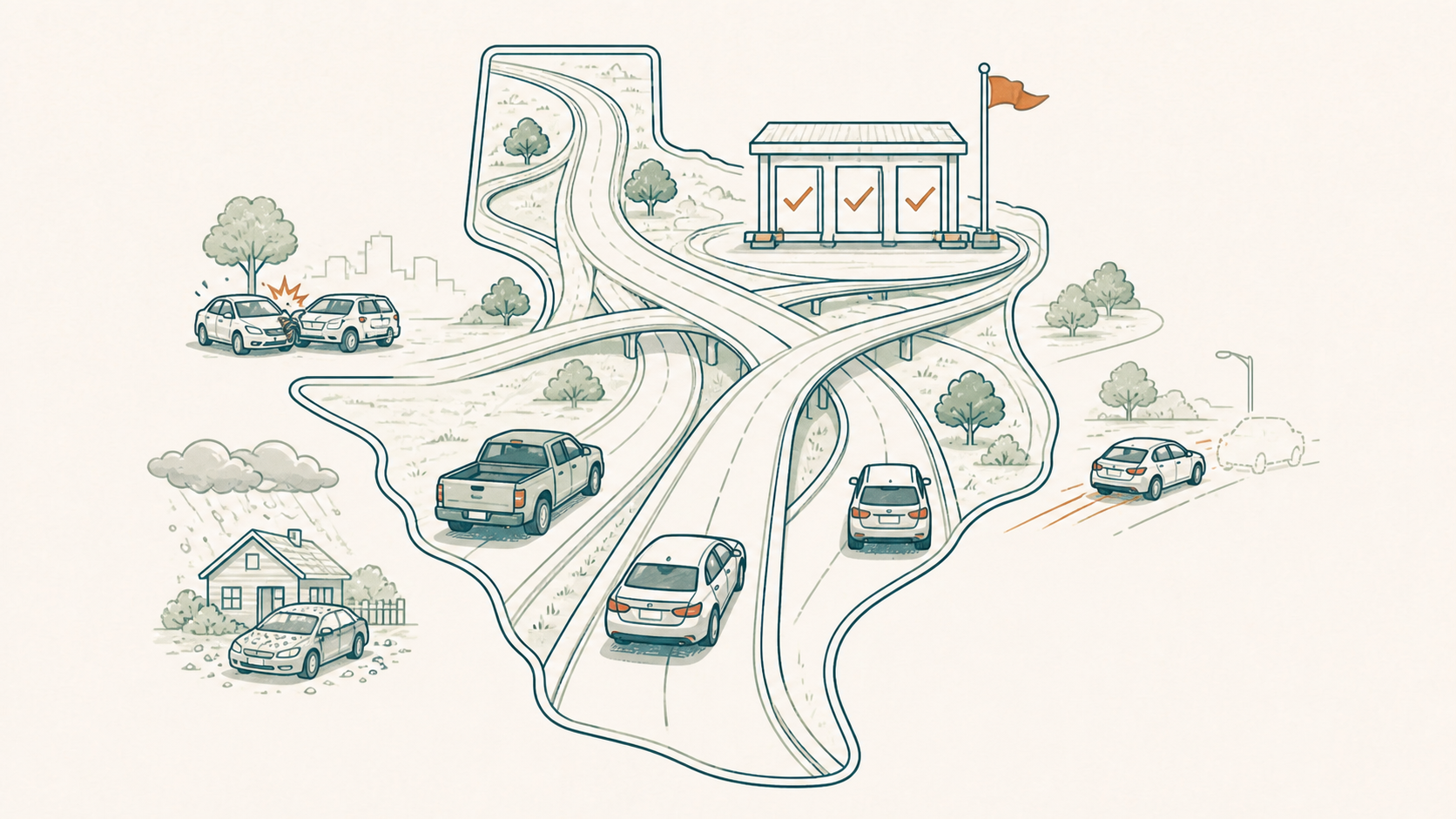
Gather every driver and vehicle, set the coverage and deductibles you want quoted, and give each source identical facts. Compare written proposals using the worksheet below. Verify the agent and insurer, then bind the replacement policy and receive written proof before canceling the old one.
- Collect drivers, license information, histories, VINs, mileage, garaging, and vehicle use.
- Disclose teens, students away, delivery, rideshare, commuting, and business use.
- Compare total term cost, not only the down payment or monthly installment.
- Confirm effective date, lienholder, ID cards, and written proof before canceling existing coverage.
Know the Texas legal floor
Texas drivers generally satisfy the state’s financial-responsibility requirement by buying liability insurance. The minimum limits are $30,000 for injuries to one person, $60,000 total for injuries in one accident, and $25,000 for property damage, commonly written 30/60/25. These limits are a legal floor, not a recommendation. If covered losses exceed them, the at-fault driver may owe the remainder.
Example: if a driver carrying the minimum property-damage limit causes $42,000 in covered damage, the policy can pay no more than $25,000. Meeting the minimum does not erase the remaining $17,000 exposure.
Make PIP and UM/UIM an informed choice
Texas auto policies include personal injury protection unless the buyer rejects it in writing. Insurers must also offer uninsured and underinsured motorist coverage, which the buyer may reject in writing. PIP can include medical expenses, lost income, and certain nonmedical costs. UM/UIM can address injuries and property damage caused by an uninsured, underinsured, or qualifying hit-and-run driver, subject to the policy. Ask for the actual price and terms before signing a rejection.
Match vehicle coverage to the risk
Collision generally addresses covered impact damage. Comprehensive generally addresses covered non-collision losses such as theft, hail, falling objects, or animal strikes. Lenders commonly require both on financed vehicles. Compare deductibles, settlement, glass, rental, towing, custom equipment, and new-car replacement.
Gap coverage can address part of the difference when a covered total-loss settlement is below a loan or lease balance, subject to its terms. Rental reimbursement commonly has both a daily limit and maximum duration.
Coordinate umbrella and total household details
Umbrella policies typically require specified underlying auto and home liability limits. Verify the proposed policy and keep named insureds, drivers, residences, and vehicles aligned. Compare fees, telematics, discount conditions, repair networks, permissive use, and what happens when a driver or vehicle changes.
Use this quote comparison worksheet
Fill in the policy form or endorsement, not just an agent's verbal description. Use each row as a question when you compare quotes.
| Compare | Quote A | Quote B | Quote C |
|---|---|---|---|
| Liability bodily-injury and property-damage limits | |||
| PIP limit or written rejection | |||
| UM/UIM bodily injury and property damage or written rejection | |||
| Collision and comprehensive deductibles | |||
| Rental daily limit and maximum duration | |||
| Towing and glass limits | |||
| Gap or new-car replacement | |||
| Permissive-use, excluded-driver, rideshare, delivery, and business-use terms | |||
| Policy term, down payment, fees, and total term premium | |||
| Telematics participation and renewal consequences |
Sources and official tools
Texas-specific guidance on this page was reviewed against these official consumer resources.
- TDI Texas auto insurance guide
Texas rules, common coverages, shopping, and claims.
- TDI auto comparison worksheet
Printable matched-policy worksheet.
- TDI uninsured motorist guide
Official UM/UIM explanation.
- HelpInsure
Texas price, complaint, discount, and company comparisons.
- TDI agent and company lookup
Verify licenses and company information.
- TDI insurers of last resort
TAIPA and other residual-market information.