Texas insurance guide · 9 minute read
Does homeowners insurance cover water damage in Texas?
Some sudden and accidental water losses may be covered, while flood, continuous leakage, maintenance, and other causes are commonly excluded or limited. The source and timing of the water matter more than the fact that something became wet.
InsuredNear editorial review · Last reviewed August 15, 2026
Classify the event before assuming coverage
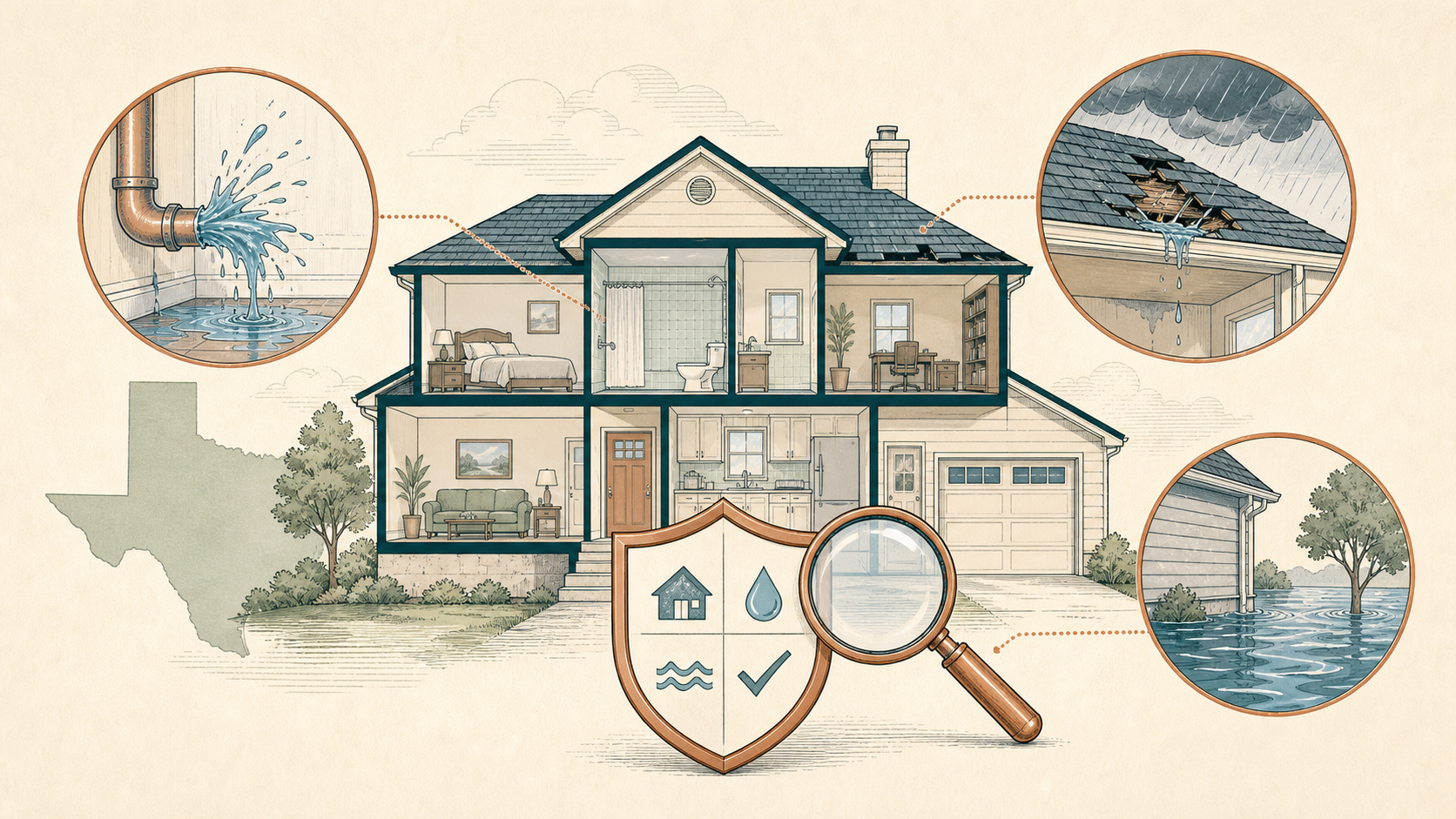
Short answer: many Texas home policies cover some sudden and accidental water damage, such as damage from a burst pipe or broken washer hose. They commonly exclude rising floodwater, continuous leakage, wear and tear, and maintenance. Sewer backup, seepage, foundation, mold, and access to failed plumbing can have separate limits or endorsements.
Coverage depends on the policy language and facts of the loss. Two rooms with identical damage can produce different results if one was damaged by a sudden pipe break and the other by months of leakage.
A sudden plumbing release may be covered
A sudden and accidental discharge from plumbing or an appliance is commonly within home-policy coverage, subject to the form, exclusions, deductible, and homeowner duties. Resulting damage to flooring, walls, or belongings may be treated differently from the failed pipe, appliance, or worn part that caused the release.
Ask whether the policy pays to access the failed plumbing, repair the access opening, dry the structure, remediate covered mold, and replace undamaged materials needed for a reasonable match. Do not assume that coverage for resulting damage pays to replace the component that wore out.
Continuous leakage and maintenance are different
A slow leak behind a wall, repeated seepage through a shower, deteriorated grout, a worn roof, or long-term moisture may be excluded even when the damage was hidden. Policy definitions can specify how long leakage must continue before an exclusion applies.
Act promptly when staining, odor, elevated water use, soft materials, or visible mold appears. Stop the source when safe, document conditions, and notify the insurer according to the policy. Delayed mitigation can increase damage and complicate a claim.
Rain entry depends on how it entered
Wind-driven rain and rain entering through an opening created by covered storm damage may be treated differently from rain entering through deterioration, faulty construction, an open window, or an existing leak. The roof's settlement terms and storm deductible can also affect the outcome.
After a storm, photograph the exterior and interior before temporary repairs when it is safe to do so. Protect the property from further damage and retain receipts, but avoid permanent work that prevents inspection unless immediate action is necessary for safety.
Sewer and drain backup may require an endorsement
Water or sewage backing up through a drain or sump is not the same event as a burst supply pipe or rising flood. Standard coverage may exclude or limit backup, while an endorsement may provide a separate limit and deductible.
Ask whether the endorsement covers cleanup, damaged building materials, belongings, and additional living expenses. Compare the sublimit with realistic remediation and reconstruction costs rather than checking only whether backup is listed.
Flood requires a separate decision
Most homeowners policies do not cover flood from rising or accumulating surface water. Flood insurance is normally purchased separately through the National Flood Insurance Program or a private insurer. A property does not need to sit inside a lender-designated high-risk zone to experience flooding.
NFIP building and contents coverage are distinct and generally carry separate deductibles. According to the National Flood Insurance Program, new coverage generally begins 30 days after purchase, with exceptions involving certain loan transactions, renewal changes, recent flood-map changes, and qualifying post-wildfire flooding. Private-policy terms and waiting periods vary.
Foundation, mold, and ensuing damage require close reading
Foundation movement, settling, earth movement, seepage, and mold often involve exclusions or limited coverage. A policy might distinguish an excluded cause from covered ensuing damage, but the exact wording and sequence of events control.
Do not rely on a contractor's conclusion about insurance coverage. Obtain the cause assessment needed to make repairs, preserve evidence, and ask the insurer for its written coverage position tied to the policy.
Compare the cause, not just the damage
- Sudden pipe or appliance release: Is resulting water damage covered even if the failed part is not? Verify access, drying, repairs, belongings, mold, and deductible.
- Repeated or hidden leakage: Does a leakage exclusion apply after a stated period? Verify definition of repeated leakage and any hidden-loss provision.
- Sewer or drain backup: Is backup excluded, limited, or endorsed? Verify sublimit, deductible, cleanup, belongings, and loss of use.
- Rising surface water: Is the event treated as flood? Verify separate flood policy, building and contents limits, and effective date.
Build a water-coverage comparison
Before a loss, ask each agent to mark covered, excluded, endorsed, or limited beside the same scenarios using the proposed policy. After damage has occurred, report the loss promptly and ask the insurer for a written coverage position; an agent's general explanation does not decide an active claim.
- Burst supply pipe
- Broken appliance hose
- Access to plumbing behind a wall or slab
- Repeated or hidden leakage
- Rain through storm-created damage
- Roof deterioration and rain entry
- Water or sewer backup
- Rising surface water and flood
- Mold testing and remediation
- Foundation or earth movement
- Temporary housing during covered repairs
Use this quote comparison worksheet
Fill in the policy form or endorsement, not just an agent's verbal description. Use each row as a question when you compare quotes.
| Compare | Quote A | Quote B | Quote C |
|---|
Sources and official tools
Texas-specific guidance on this page was reviewed against these official consumer resources.
- TDI home insurance guide
Official Texas examples of commonly covered and excluded home losses.
- TDI disaster claim FAQ
Texas guidance on storm, roof, and sudden water-damage claims.
- TDI home insurance shopping guide
Questions to ask about policy forms and additional coverage.
- NFIP policy terms
Federal information about separate flood building and contents coverage.
- OPIC: common homeowners exclusions
Independent Texas consumer information about common coverage gaps.