Texas insurance guide · 10 minute read
Should you bundle home and auto insurance in Texas?
A bundle can simplify service and unlock discounts, but the right comparison is the combined annual cost and coverage quality across every policy.
InsuredNear editorial review · Last reviewed August 9, 2026
Run three matched scenarios
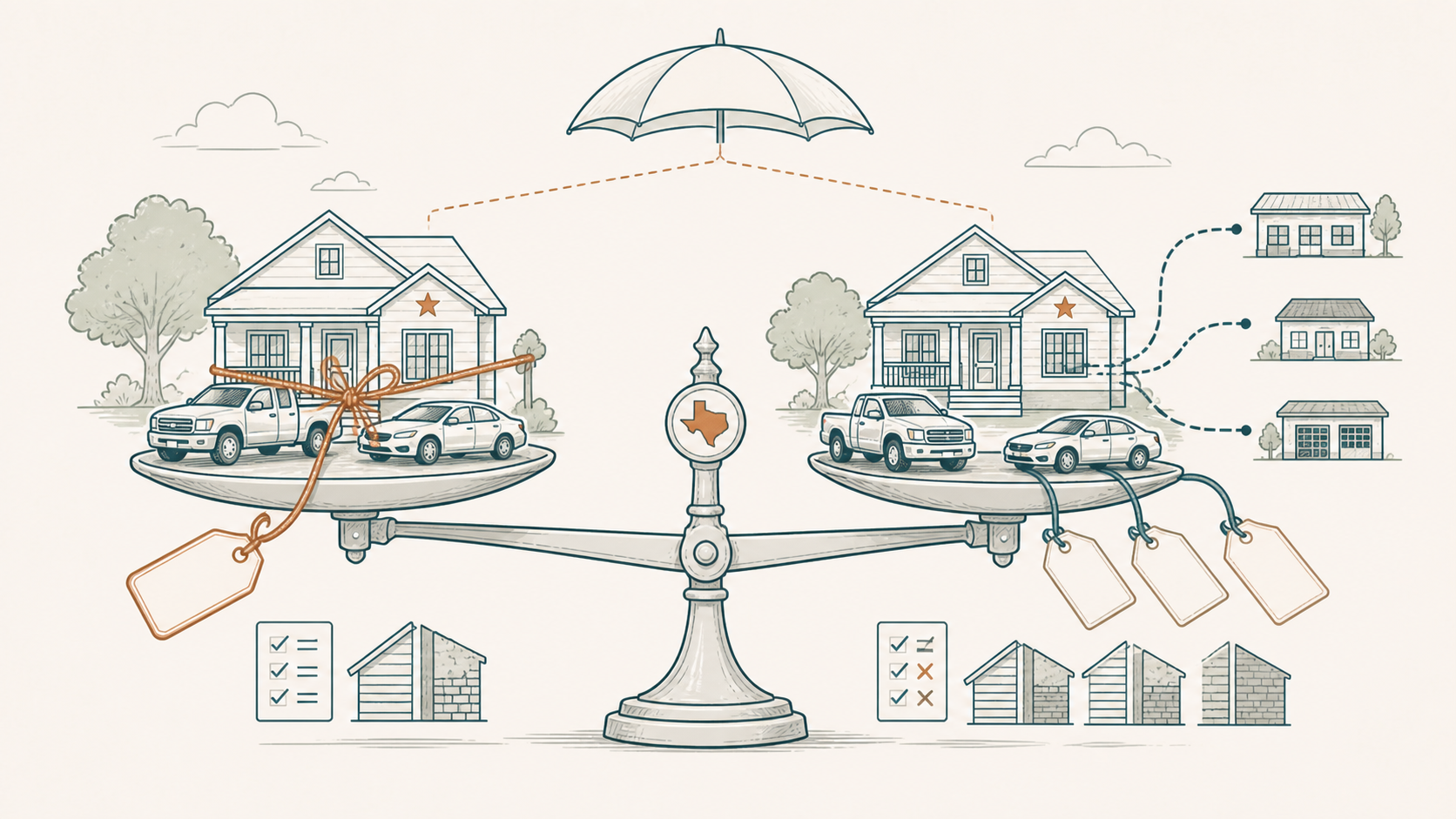
Compare the current arrangement, a matched home and auto bundle, and the best matched separate quotes you can obtain. Set acceptable coverage first. Among proposals that meet it, compare total annual cost, carrier quality, and service together. One agency can coordinate different insurers, but that is not a same-company bundle and discounts may differ.
Calculate total annual cost
Convert every policy to the same annual basis and include fees and companion policies. Example: a bundle costs $3,200 home plus $2,400 annualized auto, or $5,600. Separate proposals cost $2,850 home plus $2,550 auto, or $5,400. The advertised bundle discount does not make the bundle cheaper here. Coverage differences still must be resolved.
Know the Texas anti-tying rule
Since September 1, 2025, Texas law prohibits an insurer from requiring a consumer to buy a residential property policy and personal auto policy together from the same or an affiliated insurer. Voluntary multi-policy discounts remain permitted. Ask for the written unbundled option if a proposal appears conditional on both.
Coordinate liability and umbrella requirements
Compare named insureds, household drivers, residences, vehicles, underlying limits, required endorsements, and effective dates. Changing one underlying policy can create an umbrella compliance issue if required limits are no longer maintained. Confirm the proposed wording.
Test renewal flexibility and switching safety
Discounts and prices can change at renewal. Ask whether one policy can be remarketed without disrupting others and which discounts would change. Rerun the worksheet after a move, new driver, roof replacement, claim, vehicle change, or business use.
Bind new policies first. Verify dates, named insureds, mortgagee or lienholder details, payment, and written proof. Only then cancel old policies.
Use this quote comparison worksheet
Fill in the policy form or endorsement, not just an agent's verbal description. Use each row as a question when you compare quotes.
| Compare | Quote A | Quote B | Quote C |
|---|---|---|---|
| Home annual premium | |||
| Auto full-term premium converted to annual cost | |||
| Policy and installment fees | |||
| Multi-policy discount on each policy | |||
| Other discounts gained or lost | |||
| Flood, wind, umbrella, and companion-policy costs | |||
| Home limits, deductibles, roof settlement, and water terms | |||
| Auto liability, PIP, UM/UIM, and physical-damage deductibles | |||
| Named insureds, drivers, residences, and vehicles | |||
| Umbrella underlying limits, endorsements, and effective dates | |||
| Total annual cost | |||
| Carrier quality, service, and billing model |
Sources and official tools
Texas-specific guidance on this page was reviewed against these official consumer resources.
- TDI home insurance discounts
Official multi-policy discount guidance.
- TDI Bulletin B-0012-25
Texas anti-tying requirements effective September 1, 2025.
- TDI auto comparison worksheet
Printable matched auto worksheet.
- TDI home comparison worksheet
Printable matched home worksheet.
- HelpInsure
Texas price, complaint, and company comparisons.