Texas insurance guide · 12 minute read
Texas homeowners insurance: a practical buying guide
Use this guide as a worksheet: gather the same facts, request matched quotes, convert every deductible to dollars, and compare coverage before price.
InsuredNear editorial review · Last reviewed August 9, 2026
Follow this buying sequence
A repeatable process makes quotes easier to compare and reduces the chance that a lower premium is simply buying less protection.
- Gather your current declarations page and accurate property details.
- Request matched quotes from several sources.
- Convert every percentage deductible to dollars.
- Compare policy forms, exclusions, endorsements, and settlement methods.
- Check the carrier and agent with the Texas Department of Insurance.
- Confirm flood and wind gaps, waiting periods, and effective dates.
- Bind the new policy before canceling the old one.
Gather the same facts for every quote
Give every agent the same information so differences in the proposals reflect the coverage and carrier, not different assumptions.
- Current declarations page and desired effective date
- Home age, square footage, roof age and material
- Foundation and construction type
- Updates to plumbing, electrical, HVAC, and roof
- Prior claims and mortgage requirements
- Pools, trampolines, animals, rentals, or home businesses
Identify the policy form and settlement method
A named-perils policy covers only causes of loss listed in the contract. An open-perils policy generally covers direct physical loss unless the cause is excluded. Neither label tells you everything, so compare the exclusions and endorsements in the actual forms.
Replacement cost generally uses the current cost to repair or replace covered property, while actual cash value subtracts depreciation. Replacement cost on the dwelling does not guarantee replacement-cost settlement for the roof or belongings. Confirm each separately.
Start with the dwelling limit, not the sale price
The dwelling limit is intended to pay for covered repairs or rebuilding. It is not the home's market value, mortgage balance, or land value. Ask how the replacement-cost estimate accounts for local labor and materials, debris removal, current building codes, and distinctive features.
Ask for the exact extended replacement-cost percentage and ordinance or law limit. These can matter when catastrophe-driven construction costs rise or rebuilding must meet newer codes.
Convert every deductible to dollars
Texas policies may use a flat-dollar deductible for some losses and a percentage deductible for wind, hail, or named storms. A percentage is commonly applied to the dwelling limit, not the size of the claim.
On a home insured for $400,000, a 1% deductible is $4,000 and a 2% deductible is $8,000. Write the dollar amount beside every percentage before choosing a policy.
- All-other-perils deductible
- Wind and hail deductible
- Named-storm or hurricane deductible
- Whether more than one deductible could apply after an event
Know where Texas homeowners may need separate coverage
Most homeowners policies do not cover flood from rising water. Flood coverage is a separate decision even outside a lender-designated flood zone, and many policies have a waiting period before coverage begins.
On the Texas coast and in parts of Harris County near Galveston Bay, a homeowners policy might exclude wind and hail. Eligible properties may obtain separate coverage through TWIA. If regular-market property coverage is unavailable, ask a licensed agent whether the Texas FAIR Plan is an eligible last-resort option.
- Put homeowners, flood, and any separate wind policy effective dates side by side.
- Confirm the insured name, property address, building value, contents limit, and loss-settlement method on each policy.
- Do not wait for an approaching storm to investigate coverage or waiting periods.
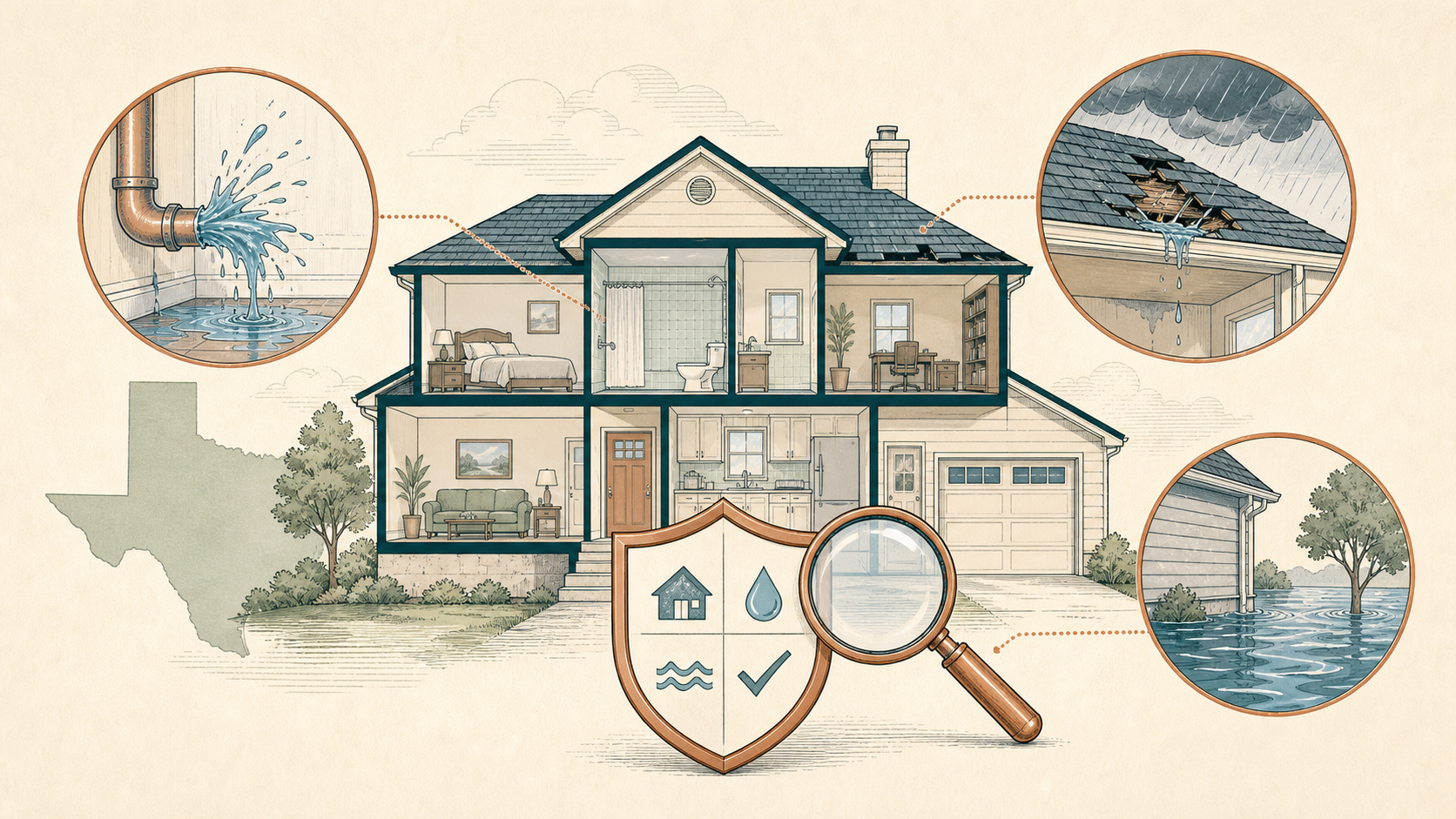
Read water, roof, and cosmetic-damage terms closely
Ask the agent to show where the proposed policy addresses each issue, including any exclusion, sublimit, or endorsement. A verbal summary is not a substitute for the form.
- Does the roof settle at replacement cost or actual cash value, and does that change with roof age?
- Is cosmetic hail damage to roofing or metal surfaces restricted?
- What sudden plumbing damage is covered, including access to the failed pipe?
- Are repeated leakage, seepage, foundation movement, mold, or water backup excluded or limited?
- What water-backup limit and deductible apply?
Build the rest of the policy around the household
Compare other structures, personal-property settlement, loss-of-use limits and duration, personal liability, and medical payments. Review special limits for jewelry, art, firearms, electronics, and home-business property. Discuss rentals, pools, animals, and whether an umbrella policy fits the household.
Create a home inventory with photos, serial numbers, and receipts for valuable items. It helps determine an appropriate contents limit and can make a future claim easier to document.
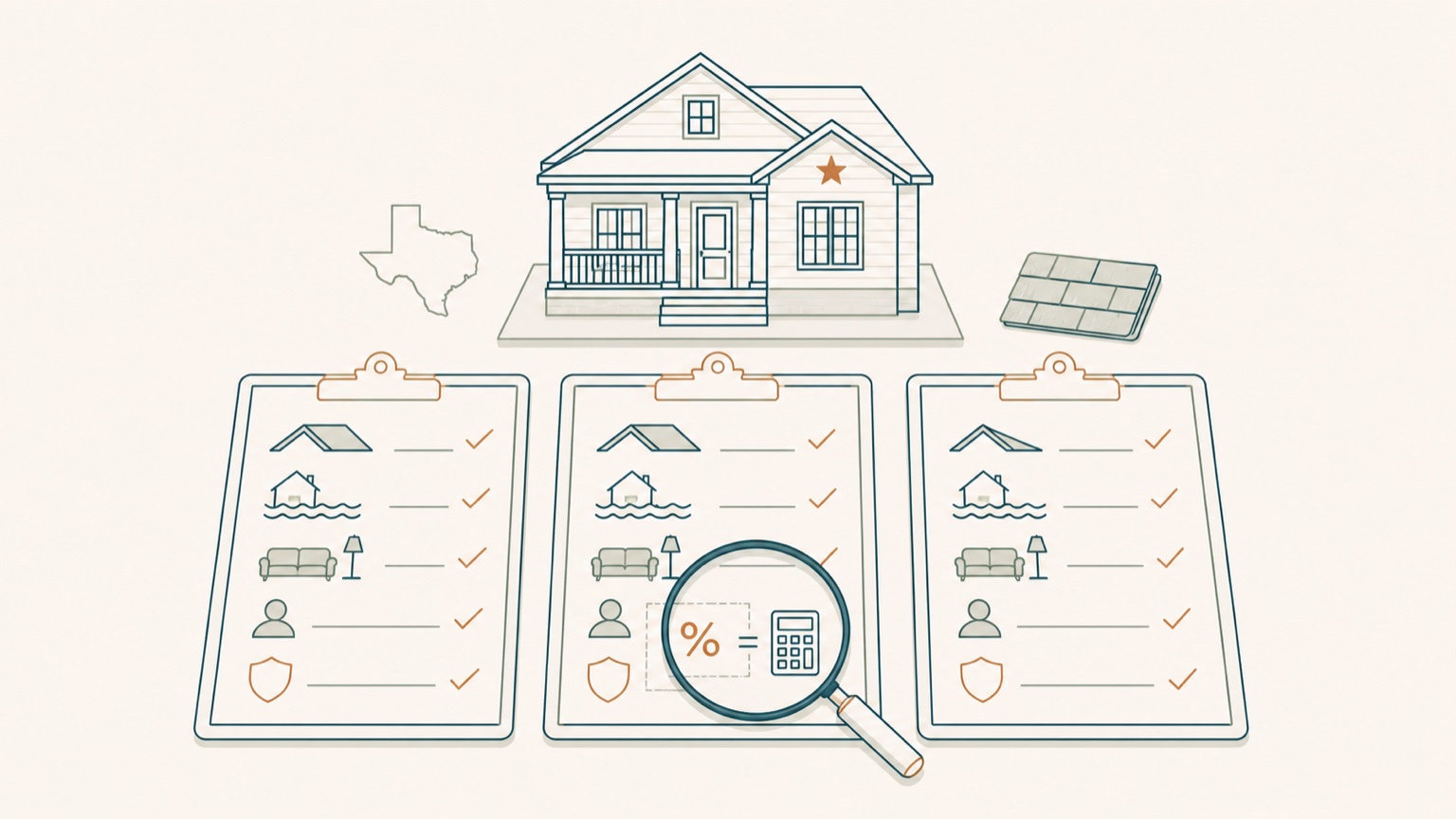
Use this quote comparison worksheet
Fill in the policy form or endorsement, not just an agent's verbal description. Use each row as a question when you compare quotes.
| Compare | Quote A | Quote B | Quote C |
|---|---|---|---|
| Policy form: named perils or open perils | |||
| Dwelling limit and replacement-cost estimate | |||
| Extended replacement-cost percentage | |||
| Ordinance or law coverage | |||
| Roof settlement: replacement cost or actual cash value | |||
| Personal-property settlement | |||
| All-other-perils deductible | |||
| Wind, hail, and named-storm deductibles in dollars | |||
| Water backup, seepage, foundation, and cosmetic-damage terms | |||
| Loss-of-use limit and time limit | |||
| Flood and separate wind coverage | |||
| Annual premium and discount conditions |
Sources and official tools
Texas-specific guidance on this page was reviewed against these official consumer resources.
- TDI home insurance shopping guide
Official shopping checklist and explanations of common coverage terms.
- TDI policy comparison worksheet
Printable side-by-side worksheet for companies and policies.
- HelpInsure
Texas sample prices, complaint information, discounts, and company comparisons.
- OPIC residential property shopping guide
Independent Texas consumer guidance on comparing cost, coverage, and options.
- TDI agent and company lookup
Check licensing, complaint information, and company details.
- Texas Windstorm Insurance Association
Wind and hail coverage information for eligible coastal properties.
- Texas FAIR Plan Association
A possible last-resort property market when regular-market coverage is unavailable, subject to eligibility.